Robotics · Localization · Experimental Systems
Follow Me — Robust UWB Localization and Control for a Mobile Robot
Experimental development and validation of a UWB-based robotic tracking system combining real-world sensor characterization, empirical noise modeling, localization, filtering, feedback control, ROS 2 simulation, and transfer to physical hardware.
- Role
- Bachelor's Thesis Research Project
- Institution
- EPFL Automatic Control Laboratory
- Date
- Feb 2026 – Jun 2026
- Context
- Three-person team
- Grade
- 6.0 / 6.0
Technologies
Context
Context
Conducted at the EPFL Automatic Control Laboratory as a three-person bachelor's thesis research project, the work developed and experimentally validated the sensing, localization, and control components of a UWB-based follow-me robot. Rather than assuming an idealized sensor, it started from physical Ultra-Wideband measurements, characterized their imperfections, and built empirical noise models that fed a localization and feedback-control pipeline implemented in ROS 2 and Gazebo before transfer to physical rover hardware.
Problem
Problem
Ultra-Wideband ranging is attractive for indoor localization but, in practice, suffers from measurement bias, non-Gaussian noise, multipath reflections, and intermittent dropouts.
A two-anchor configuration introduces a geometric ambiguity: distance measurements alone cannot always resolve which side of the anchor baseline the target lies on.
Timing failures and lost packets break naive filtering assumptions, so the estimator has to remain stable under irregular, real-world data rates.
Scope
System scope
ESP32 and DW3000 UWB sensing
Measurement bias, noise, multipath, and dropout analysis
Empirical noise models derived from physical experiments
ROS 2 and Gazebo localization and control pipeline
Gyroscope-assisted ambiguity resolution
Simulation-to-hardware integration
Methods
Approach & methods
Characterized ESP32 + DW3000 UWB sensing through controlled physical experiments, measuring bias, noise, multipath, and dropout behavior.
Derived empirical noise models directly from the collected experimental data rather than relying on datasheet assumptions.
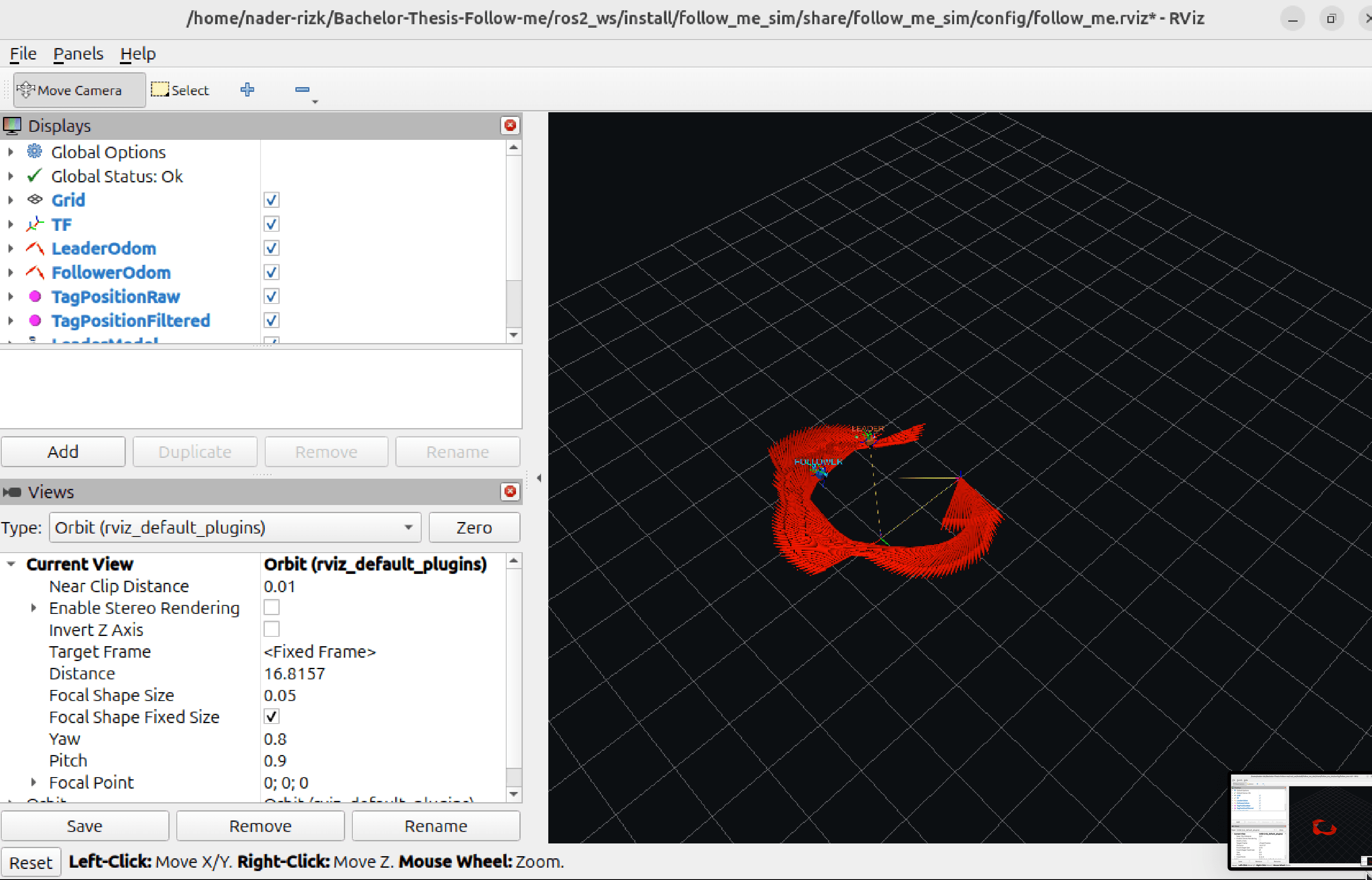
Built a localization and feedback-control pipeline in ROS 2 with a Gazebo simulation environment to iterate safely before touching hardware.
Used gyroscope-assisted information to disambiguate the two-anchor localization geometry.
Transferred the modular pipeline from simulation to physical rover hardware to validate the core components in the real world.
Contributions
Contributions
This was a three-person bachelor's thesis research project; the points below describe the team's work rather than claiming sole individual ownership.
Physical UWB experiments and characterization of bias, noise, multipath, and dropout behavior.
Empirical noise models derived from the experiments and integrated into the localization and filtering stages.
ROS 2 / Gazebo localization and feedback-control pipeline, including gyroscope-assisted disambiguation, and transfer to physical rover hardware.
Results
Results
Thesis grade
6.0 / 6.0
Highest possible grade
Sensing stack
ESP32 + DW3000
Ultra-Wideband ranging
Pipeline
ROS 2 / Gazebo
Simulation to hardware
Process
Technical process
- 01UWB sensing
- 02Raw distance data
- 03Filtering
- 04Localization
- 05Control
- 06Physical rover
Limitations
Limitations
The two-anchor configuration retains an inherent geometric ambiguity; gyroscope information mitigates but does not fully eliminate degenerate cases.
Localization quality remains sensitive to multipath and physical obstructions in the environment.
A fully autonomous, end-to-end robotic system was not exhaustively validated; the work validates the core sensing, localization, and control components.
Hardware and integration constraints limited the range of experimental conditions that could be covered.
Lessons
Lessons learned
Empirical, experiment-driven noise characterization mattered more than idealized sensor assumptions.
Validating in ROS 2 / Gazebo before hardware made the simulation-to-hardware transfer far less brittle.
Modular components made it easier to reason about where ambiguity and failure originated.
Next steps
Next steps
Extend to additional anchors to remove the geometric ambiguity entirely.
Investigate more expressive noise models for multipath-heavy environments.
Broaden hardware testing across varied indoor settings.
Report