Computer Vision · Experimental Measurement
Computer Vision Measurement System
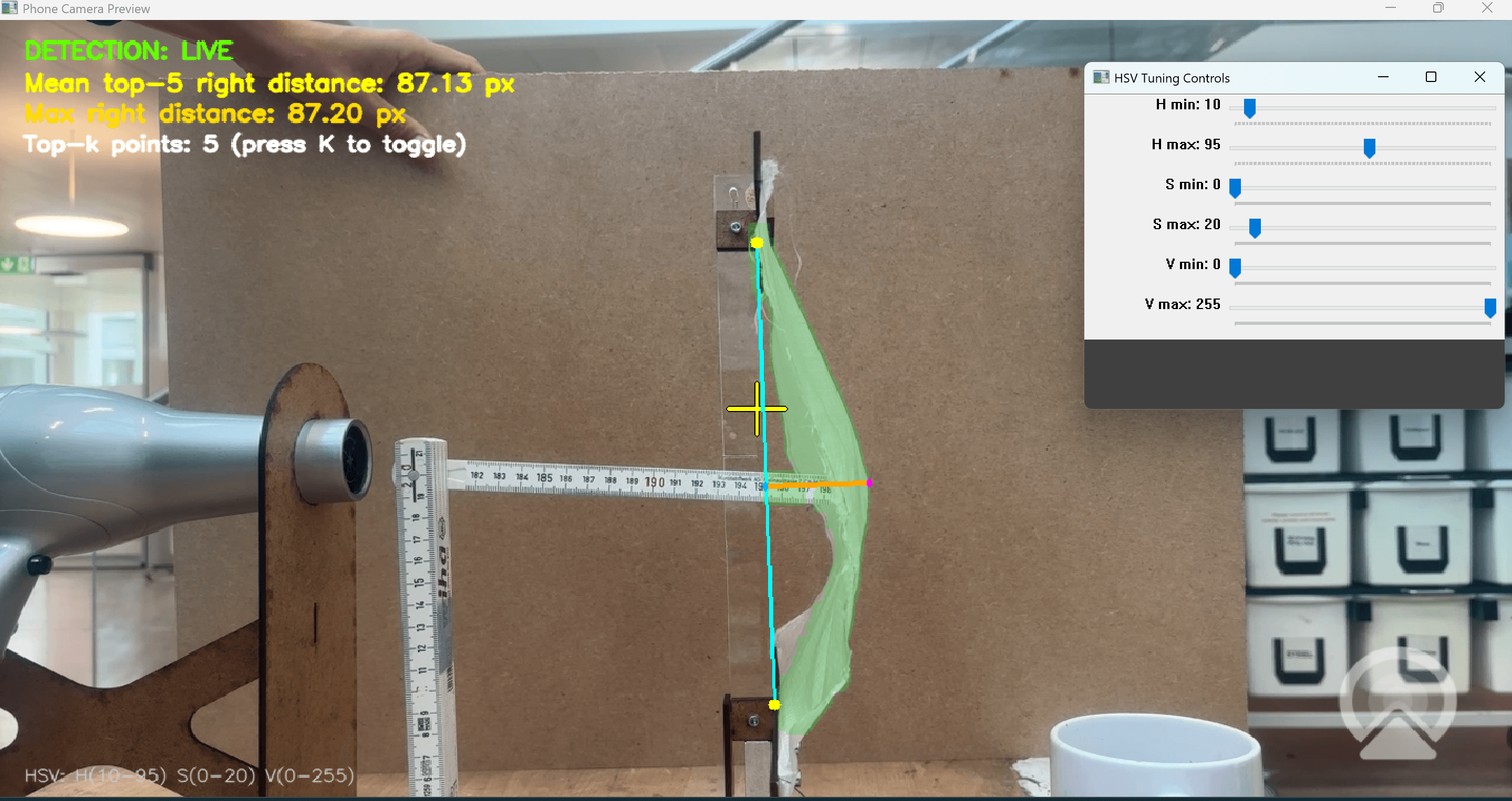
Built an OpenCV-based system that converts experimental video into a calibrated, time-resolved physical displacement signal.
- Role
- Image-processing and calibration pipeline within a four-person engineering team
- Context
- Four-person team
Technologies
Context
Context
Within a four-person engineering project, this work delivered the image-processing and calibration pipeline: an OpenCV-based system that turns live experimental video into a calibrated, time-resolved physical displacement signal — segmenting a tracked marker, extracting its position, and converting pixel motion into millimetres relative to a user-defined reference axis, with results logged for later analysis.
Problem
Problem
Experimental video contains lighting variation, noise, and background clutter that a robust measurement pipeline has to tolerate.
Turning pixel motion into a physically meaningful displacement requires a careful, explicit calibration and a stable reference geometry.
Measurements need to be produced and displayed in real time while remaining reproducible after the experiment.
Scope
System scope
Live video acquisition
HSV segmentation and mask cleaning
Contour extraction and marker tracking
Pixel-to-millimetre calibration
Real-time display and CSV logging
Methods
Approach & methods
Acquired live video and segmented the tracked marker using HSV colour thresholds.
Cleaned the resulting binary mask and extracted contours to locate the marker reliably.
Let the user define a reference axis, then computed the perpendicular distance from the marker to that axis.
Applied a fixed pixel-to-millimetre calibration to convert the signal into physical units.
Displayed the measurement in real time and logged timestamped values to CSV for downstream analysis.
Contributions
Contributions
Owned the image-processing and calibration pipeline within a four-person engineering team.
Covered acquisition, segmentation, contour extraction, calibration, real-time display, and CSV logging.
Other parts of the broader experiment (e.g. force, inertial, and frequency-domain analysis) were handled by other team members.
Results
Results
Calibration
0.591 mm / pixel
Fixed pixel-to-millimetre scale
Experimental runs
14
Recorded and processed
Median temporal variability
≈ 0.65 mm
Across runs
Process
Technical process
- 01Frame
- 02HSV mask
- 03Contour
- 04Calibrated displacement
- 05CSV
Limitations
Limitations
A fixed pixel-to-millimetre calibration assumes a stable camera-to-scene geometry and does not correct for perspective changes.
HSV segmentation is sensitive to lighting conditions and marker colour contrast.
The pipeline measures displacement along a single user-defined axis rather than full-field deformation.